
Roof Repair vs. Replacement: How Murray Homeowners Should Decide
Published on October 14, 2026
Published on October 14, 2026
Published on October 14, 2026
The repair-vs-replace decision comes down to three things: the roof's age, the extent of the damage, and the math. Here is how to think about each.
Start with the roof's age
A 10-year-old architectural shingle roof with a localized leak is a repair candidate. A 24-year-old roof with the same leak is a replacement candidate wearing a repair's clothing. Age sets the context for every other factor.
Map the extent of the damage
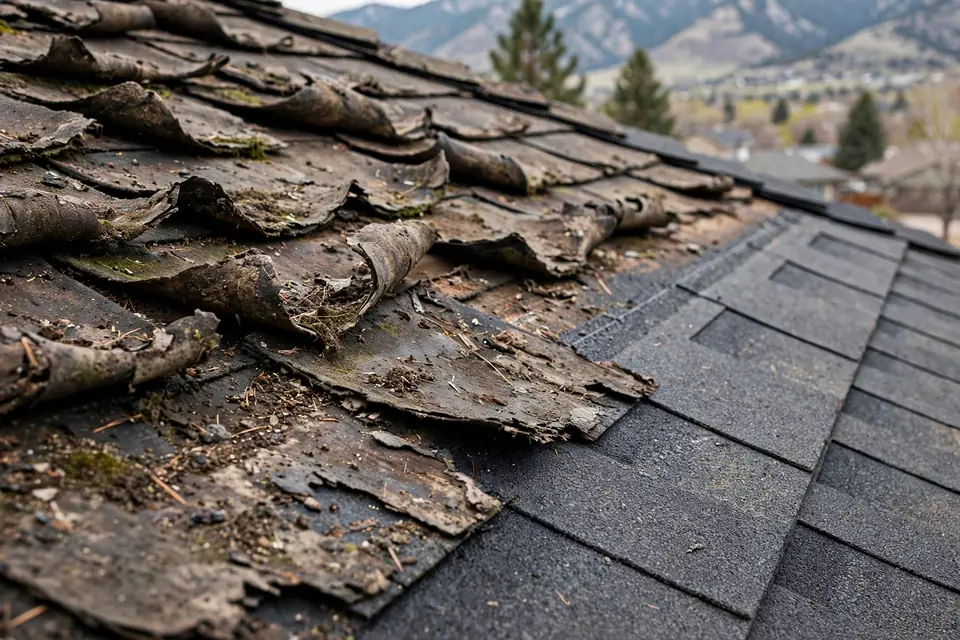
One failed valley or a small wind-damaged area points to repair. Multiple leaks, widespread granule loss, or damage across several slopes points to replacement. We document damage slope by slope so you can see the pattern, not just hear our opinion.
Do the five-year math
Add up the repair cost plus the likely cost of the replacement you will still need in a few years, and compare it to replacing now. Repairs on a dying roof are often 30-50 percent of a replacement — spent for two or three years of borrowed time.
Consider the hidden factors
Insurance may cover replacement after storm damage but not wear. Selling soon? A new roof is a strong listing asset in Murray's market. Layering repairs onto a roof with multiple existing layers can also create weight and code issues.
Need roof replacement in Murray? Call (888) 974-0663 today.
Call NowEmergency Quick CallRelated Services
Areas We Serve
South Salt Lake
Roof replacement in South Salt Lake, Murray.
Millcreek
Roof replacement in Millcreek, Murray.
More Guides
How Much Does Roof Replacement Cost in Murray?
Guide from Roof Replacement Masters.
7 Signs Your Murray Home Needs a Roof Replacement
Guide from Roof Replacement Masters.
The 25% Rule and Other Decision Math
A useful rule of thumb: if the repair cost exceeds roughly 25% of replacement cost and the roof is past 75% of its rated life, replacement usually wins economically. The math behind it: repairs on an aging roof buy diminishing time (each fix lasts fewer years as the system degrades), while replacement resets the clock completely — and you're paying mobilization once instead of repeatedly.
Run the per-year numbers: a $2,000 repair buying 3 years costs $667/year; a $15,000 replacement buying 25 years costs $600/year — and the replacement includes new flashing, ventilation, and warranty. When the repair estimate starts approaching the rule-of-thumb threshold, ask for the replacement quote too. Compare honestly.
When Repair Is Clearly Right
Repair wins when the roof is young (under half its rated life), the damage is genuinely isolated (a limb puncture, a failed boot, a small wind event), and the surrounding system is sound — verified by inspection, not assumed. A 10-year-old architectural roof with a failed pipe boot needs a boot, not a roof.
The honest contractor's test: would we warranty the repair? If the surrounding roof is sound enough that a targeted fix will last, repair is the right recommendation — and we'll say so, even though replacement pays us more. That's how you know the advice is real.
The Partial Replacement Middle Ground
Between full repair and full replacement sits an option Murray homeowners use more often than the industry discusses: partial replacement. When damage or wear is concentrated on one or two slopes — the south-facing slope baked by sun, or the north slope that never fully dries — replacing just those slopes can be the rational call. The economics work when the remaining slopes have genuine remaining life (verified by inspection, not assumed) and when the new shingles can be reasonably matched to the existing ones.
The honest caveats: shingle dye lots change, so a perfect color match on a ten-year-old roof is unlikely — plan for a visible but tasteful transition at a ridge or valley line, which reads as intentional rather than patched. Warranties on partial work cover the replaced slopes, not the whole roof, and that should be in writing. And partial replacement never makes sense as a way to dodge an inevitable full replacement by more than a few years; if the whole roof is at end of life, doing it in halves just means paying mobilization twice. Used correctly — one failing slope on an otherwise healthy mid-life roof — partial replacement is not a compromise. It is precision.
Frequently Asked Questions
Will a roofer honestly tell me when repair is enough?
We will — and we do regularly. Repairs are profitable work; we recommend them whenever they are genuinely the right call. Our reputation in Murray depends on that honesty.
Can I do a partial replacement instead?
When damage is confined to one or two slopes and the rest of the roof is healthy, a partial replacement splits the difference well. We offer it whenever the assessment supports it.