
7 Signs Your Murray Home Needs a Roof Replacement
Published on October 14, 2026
Published on October 14, 2026
Published on October 14, 2026
Published on October 14, 2026
Most roofs do not fail overnight — they send warnings for years. Here are the seven signs Murray homeowners should never ignore, and what each one means.
1. Curling, cupping, or clawing shingles
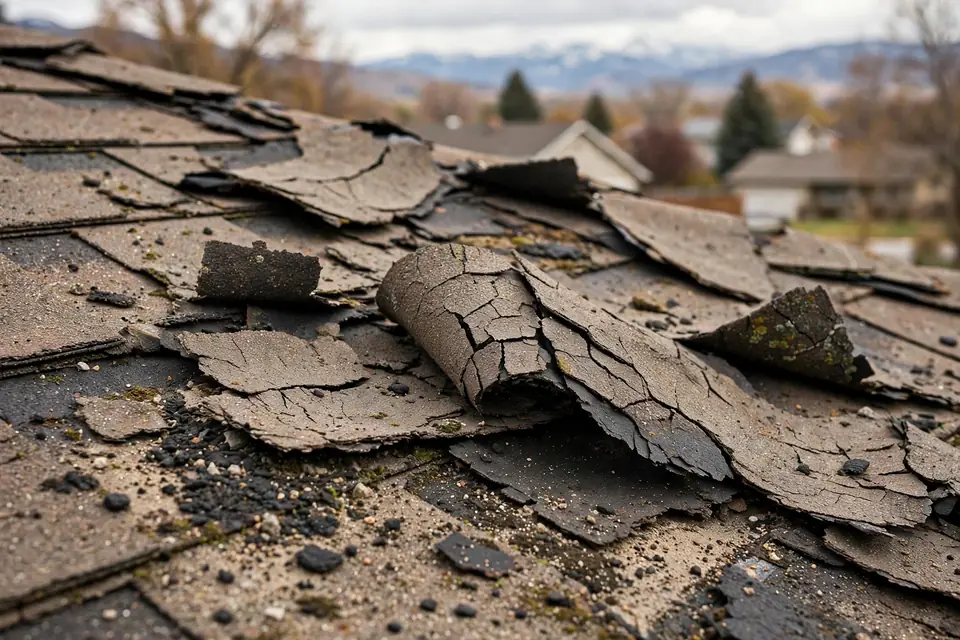
When shingle edges turn up or the centers bubble, the asphalt is drying out and the shingle is losing its ability to shed water. In Murray's heavy Wasatch Front snow, freeze-thaw cycles, and intense high-altitude UV, this aging accelerates — curled shingles are past their prime.
2. Granule loss and bald spots
Those sand-like granules protect the asphalt from UV. Check your gutters: heavy granule buildup means the shingles are thinning. Bald spots are shingles on borrowed time.
3. Cracked, missing, or wind-lifted shingles
A few missing shingles after a storm can be repaired. Widespread lifting or cracking across slopes means the fastening system is failing and replacement is the economical fix.
4. Daylight or water stains in the attic
Go into the attic on a sunny day. Pinpoints of daylight mean holes; dark staining on the deck means active or past leaks. Either way, the roofing system is compromised.
5. Sagging roof planes
A sagging deck indicates structural or sheathing damage — often from long-term moisture. This needs professional assessment promptly, not next season.
6. Moss, algae, and persistent staining
In Murray's damp microclimates, biological growth holds moisture against the shingles and accelerates decay. Some staining is cosmetic; widespread colonization is not.
7. Age: the calendar does not lie
Three-tab shingles last 15-20 years here; architectural shingles 20-30. If your roof is past its material's expected life, start planning the replacement on your schedule instead of the roof's.
Need roof replacement in Murray? Call (888) 974-0663 today.
Call NowEmergency Quick CallRelated Services
Areas We Serve
South Salt Lake
Roof replacement in South Salt Lake, Murray.
Millcreek
Roof replacement in Millcreek, Murray.
More Guides
How Much Does Roof Replacement Cost in Murray?
Guide from Roof Replacement Masters.
Roof Repair vs. Replacement: How Murray Homeowners Should Decide
Guide from Roof Replacement Masters.
The Attic Inspection: What to Look For Up There
The attic tells the roof's truth: with a flashlight, check for daylight through the deck (pinholes are normal wear; streams are failure), water staining on sheathing or rafters (active or past leaks), sagging between rafters (deck failure), and frost or moisture on nails in winter (ventilation failure). Note the decking type — plank, plywood, OSB — and its general condition.
Safety first: walk only on joists or floored areas, watch for exposed nails, and don't disturb insulation more than necessary. If the attic is inaccessible or you're unsure, our free inspection covers it — we'd rather check than have you risk it.
Age by Material: When the Calendar Says It's Time
Three-tab shingles: 15–20 years in Murray's climate (less on sun-blasted slopes). Architectural shingles: 22–30 years depending on installation quality and ventilation. Wood shake: 20–25 years with maintenance, less without. Standing-seam metal: 40–50+ years. Membrane (flat): 15–25 years depending on system and maintenance.
These are ranges, not guarantees — a well-ventilated architectural roof can exceed 30 years; a suffocated one can die at 18. Age plus the physical signs together make the call: an old roof that looks fine deserves inspection, not assumption; a young roof with multiple failure signs deserves attention, not dismissal.
The One Sign Most Homeowners Miss Entirely
Ask homeowners what roof failure looks like and they picture missing shingles. The sign they actually miss — the one that shows up in attics across Murray every spring — is nail pops pushing through the decking. As plywood expands and contracts through Utah's freeze-thaw cycles, nails work their way up; from inside the attic you will see nail tips protruding through the sheathing, sometimes with rust halos. From outside, the corresponding shingles sit slightly lifted — not enough to notice from the street, but enough to break the sealant bond and let wind-driven rain travel sideways underneath.
Nail pops matter because they are systemic, not isolated. A dozen pops across multiple slopes signal that the fastening system is aging out, and refastening individual shingles is triage, not treatment. They also accelerate everything else: each lifted shingle is a wind-catch point and a water channel, turning a roof that looks "mostly fine" from the curb into one that fails in the next big storm. During your attic check, run a gloved hand lightly along the sheathing — if you feel multiple protruding nail tips in a single bay, mention it specifically when you call for an inspection. It is the detail that tells a professional this roof is closer to done than it looks.
Frequently Asked Questions
My roof is 22 years old but looks okay. Should I replace it?
Get an inspection. Some 22-year-old roofs have five good years left; others are one storm from failure. An honest assessment beats guessing — we will tell you which one yours is.
Can I just repair the bad spots?
Spot repairs make sense when damage is truly localized and the roof is mid-life. When the warning signs are widespread, repairs become a subscription you keep paying until the inevitable replacement.