
Roof Decking Replacement: What Is Under Your Shingles Matters
Published on October 14, 2026
Published on October 14, 2026
Published on October 14, 2026
The deck is the foundation your entire roof depends on — and the part homeowners never see. Here is what Murray roof decking is, when it needs replacement, and what it costs.
What roof decking does
Decking (usually plywood or OSB sheathing) spans your rafters and gives every other roofing layer something to fasten to. It carries the roof's weight, resists wind uplift, and provides the nailing surface that holds your shingles through storms.
How decking fails
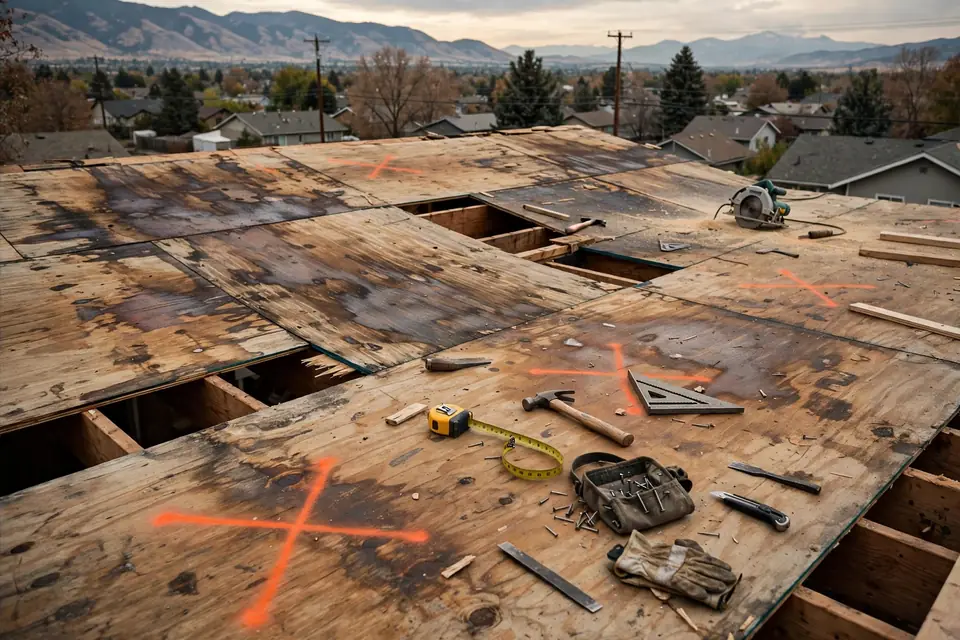
Chronic leaks rot sheathing from above; attic moisture delaminates it from below; and in Murray's older homes, original thin sheathing simply ages out. Delamination, soft spots, and sagging between rafters are the classic symptoms — most discovered only at tear-off.
What replacement involves
Damaged sheets are cut out and replaced with new code-compliant sheathing, properly gapped and nailed. We photograph every replaced section and charge a pre-agreed per-sheet price — no surprise change orders, no vague allowances.
Why it matters for your new roof
Manufacturer warranties assume sound decking. Nailing new shingles into rotted wood is like building on sand — fasteners pull out, warranties void, and the new roof's life is cut short. Redecking during replacement is the cheapest structural insurance you can buy.
Need roof replacement in Murray? Call (888) 974-0663 today.
Call NowEmergency Quick CallRelated Services
Areas We Serve
South Salt Lake
Roof replacement in South Salt Lake, Murray.
Millcreek
Roof replacement in Millcreek, Murray.
More Guides
How Much Does Roof Replacement Cost in Murray?
Guide from Roof Replacement Masters.
7 Signs Your Murray Home Needs a Roof Replacement
Guide from Roof Replacement Masters.
Plank vs. Plywood: What You're Likely to Find
Murray's housing history writes the decking story: pre-1960 homes usually have plank decking (1x boards with gaps), 60s–70s homes have early plywood (thinner than modern, often delaminating), and later homes have modern OSB or plywood. Plank with tight gaps and sound wood can be sheathed over; wide gaps, rot, or a century of moisture mean replacement. Early plywood delaminates in sheets — when it goes, it goes in zones.
The assessment is visual and tactile: we walk the deck during tear-off, probe soft spots, and check from the attic where accessible. Every sheet's fate is decided by condition, not by rule — sound stays, compromised goes, photographed throughout.
How Redecking Is Priced (and How to Avoid Surprises)
Honest redecking pricing is per sheet (4x8), quoted upfront: you should see the per-sheet price in the estimate before work begins, with the final count reconciled to actual sheets replaced and photo-documented. Beware two pricing games: the vague 'allowance' that's always exceeded, and the per-sheet price that's triple the material cost with no labor justification.
The likely range should also be discussed at estimate time — based on the attic inspection and the roof's age, an experienced roofer can usually predict whether you're looking at partial (eaves and valleys) or extensive redecking. The final number lands within the discussed range far more often than not, because the patterns are consistent.
Why Some Bids Include Redecking and Others Don't
Decking line items vary wildly between bids, and the difference is usually about assumptions, not honesty. A bid that includes a per-sheet replacement price with a stated quantity ("up to 5 sheets included, $X per additional sheet") is pricing the risk transparently. A bid with no decking line at all is either assuming your deck is perfect — a gamble — or planning to present the cost as a surprise change order mid-job, when you have no leverage. Neither is automatically wrong, but only the first is professional.
What you want in writing: the per-sheet price for plywood replacement, what thickness will be used (it must match or exceed existing), and the process for authorizing additional sheets — ideally with photo documentation texted to you before the work proceeds. Be wary of bids that include full redecking on every job as a default; on a sound plank deck, that is upselling, not diligence. And be equally wary of the bid that is thousands lower with no decking provision at all — the savings evaporate the moment the crew finds the first soft sheet. Decking is the one part of the job nobody can price accurately sight unseen, which is exactly why the mechanism for pricing it matters more than the number.
Frequently Asked Questions
How much does redecking cost?
We price per 4x8 sheet, agreed before work starts. Most replacements need zero to a handful of sheets; badly neglected roofs can need more. You pay only for what is actually replaced, with photos.
Can you tell if I need redecking before tear-off?
Partially — attic inspection reveals some issues. But the full picture only emerges at tear-off, which is why per-sheet pricing with documentation is the honest approach.