
Snow Load and Your Roof: What Murray Homeowners Must Know
Published on October 14, 2026
Published on October 14, 2026
Published on October 14, 2026
Wasatch Front snow is beautiful and brutally heavy. Here is how snow load affects roof replacement decisions in Murray — from structural capacity to ice dams.
How much snow your roof must handle
Building codes in the Salt Lake Valley require roofs to handle significant ground snow loads, with higher requirements up the benches. A replacement is the right moment to verify your structure meets current load standards — especially on older homes or those with added layers.
Ice dams: the real winter enemy
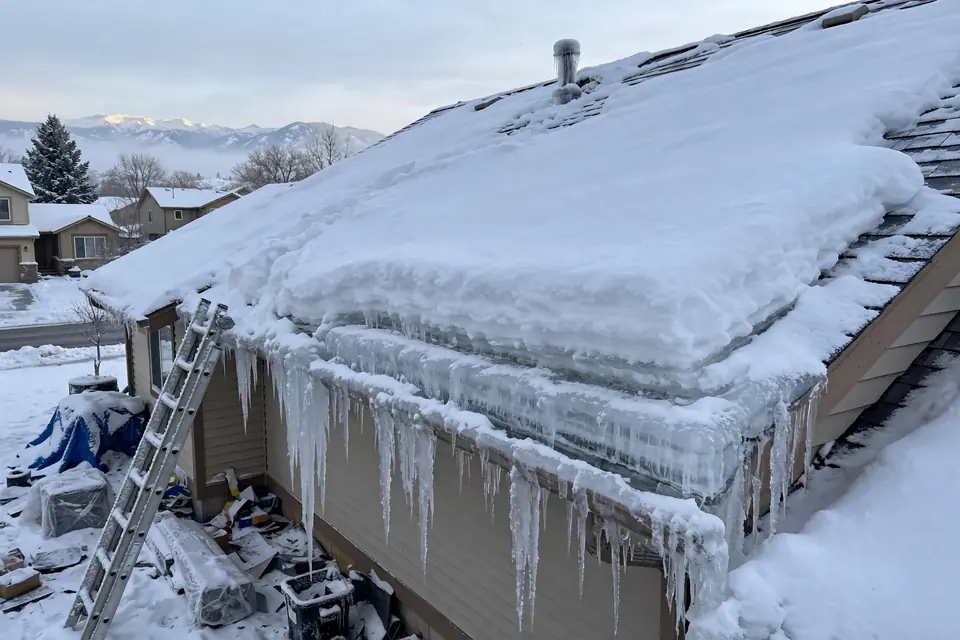
Ice dams form when heat escaping into the attic melts roof snow, which refreezes at the cold eaves — backing water under shingles. The defense is a system: sealed eaves with ice-and-water shield, balanced ventilation keeping the roof deck cold, and adequate insulation. We build all three into every Murray replacement.
Material choices for snow country
Standing-seam metal sheds snow dramatically, reducing load and ice-dam risk. Architectural shingles with full ice-and-water shield at eaves and valleys perform well too. Either way, snow guards or retention above entries and garages prevent dangerous slides.
What to watch for each winter
After heavy storms, watch for uneven melting patterns (a sign of heat loss), icicles at eaves, and interior ceiling stains. A well-built replacement minimizes all three — but no roof is maintenance-free in a real winter climate.
Need roof replacement in Murray? Call (888) 974-0663 today.
Call NowEmergency Quick CallRelated Services
Areas We Serve
South Salt Lake
Roof replacement in South Salt Lake, Murray.
Millcreek
Roof replacement in Millcreek, Murray.
More Guides
How Much Does Roof Replacement Cost in Murray?
Guide from Roof Replacement Masters.
7 Signs Your Murray Home Needs a Roof Replacement
Guide from Roof Replacement Masters.
How Much Snow Is Too Much: The Numbers
Utah residential roofs are typically designed for ground snow loads of 30+ psf (pounds per square foot) in the valley, higher on the benches — which translates to roughly 2–3 feet of settled snow depending on density. Wet spring snow is the heavyweight: a foot of wet snow can weigh as much as three feet of light powder. Drifting against dormers and valleys concentrates loads far above the average.
Warning signs of overload: interior doors sticking (frame racking), new cracks in drywall, creaking sounds, or visible sagging. These are structural warnings — call a professional immediately, don't just rake the snow. Most Murray homes handle design loads fine; the danger is the exceptional storm on the already-loaded roof.
Safe Snow Removal: What You Can and Can't Do
Roof rakes from the ground: yes, for the lower few feet — it reduces ice-dam fuel without risking the roof. Climbing on a snow-loaded roof: no, ever — it's the most dangerous roofing activity, combining fall risk, structural uncertainty, and cold. Ice dam steaming: yes, by professionals with the right equipment; chipping: no, it destroys shingles.
The strategic approach: keep gutters clear in fall (drainage prevents half the ice-dam problem), ensure attic ventilation and insulation are adequate (the long-term fix), and after exceptional storms, have the lower roof raked professionally if loads look extreme. Prevention beats removal every time.
Ice Dams: Prevention During Replacement
Ice dams are the winter roof problem Murray homeowners actually call about, and replacement is the only time you can engineer them out rather than manage them. An ice dam forms when heat escaping through the roof deck melts snow from below; the meltwater runs down to the cold eave, refreezes, and builds a dam that forces water backward under the shingles. The prevention stack has three layers, and all three are installed during replacement: air sealing the attic floor to stop heat escape, adequate insulation to keep the deck cold, and balanced ventilation to carry away whatever heat remains.
The fourth layer is the insurance policy: ice-and-water shield membrane along the eaves, extending from the edge up past the interior wall line — in Murray's climate, two courses (about six feet) rather than the code minimum. This self-sealing membrane is the last line of defense; even if a dam forms, water cannot reach the decking. If your current roof grows icicles every winter, say so during the estimate — it is diagnostic information, not small talk. A contractor who hears "ice dams" and does not discuss attic air sealing and eave membrane in response is quoting you a new roof without fixing the reason the old one suffered. The shingles are the uniform; the dam prevention is the game.
Frequently Asked Questions
Should I rake snow off my roof?
For most well-built roofs, no — raking risks shingle damage. Remove snow only from problem areas like valleys behind dormers, or if an exceptional storm exceeds design loads. When in doubt, call us before you climb up.
Do I need snow guards with a metal roof?
Above walkways, driveways, and entries — absolutely. Metal sheds snow in dramatic slides, and retention devices manage where it goes. We include them in every metal replacement quote.